



(2nd LD ) Lee vows support for semiconductor ecosystem in global AI race
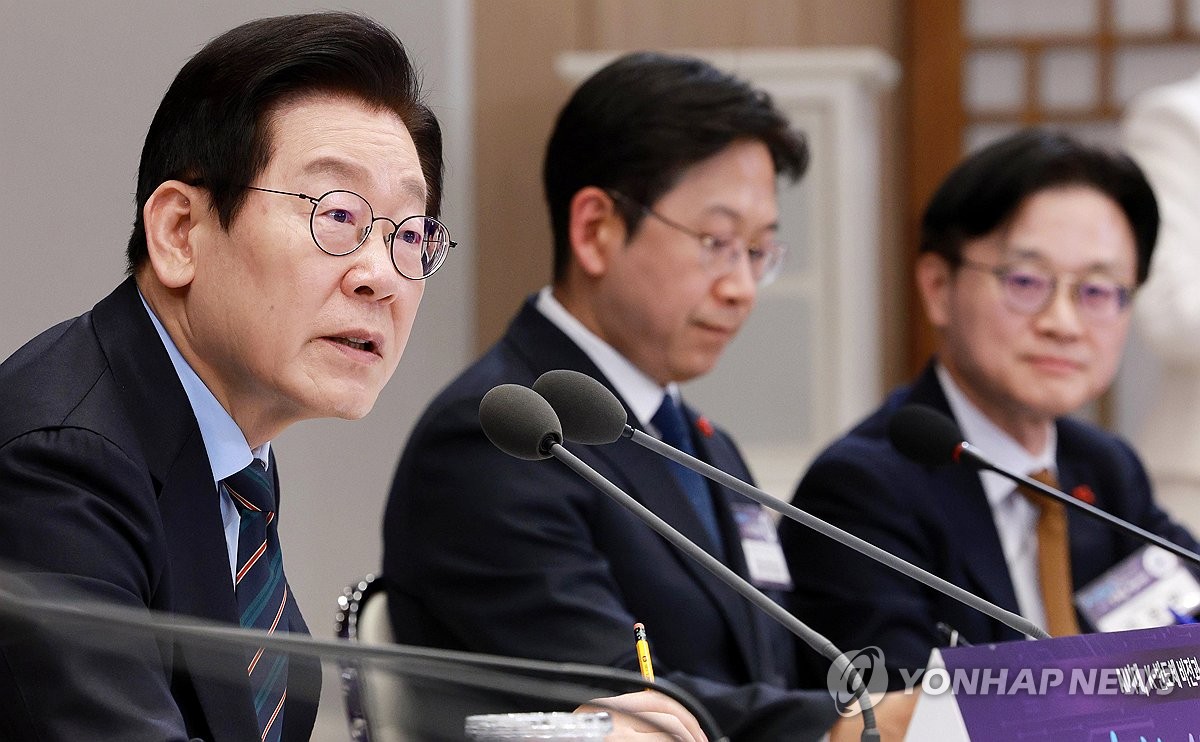
SEOUL, Dec. 10 (Yonhap) -- President Lee Jae Myung said Wednesday that South Korea's semiconductor industry should strengthen its competitiveness by advancing the entire industrial ecosystem to meet growing demand in the era of rapidly evolving artificial intelligence (AI).
Lee outlined his vision for the strategic industrial sector during a meeting with business leaders, industry officials and experts to discuss plans to promote high-performance chips that power AI technologies amid an intensifying global competition.
"Semiconductors are a sector where we hold a competitive edge," he said. "The government will make the utmost effort to advance the semiconductor industry."
Although expanding the overall market is essential, Lee emphasized a more inclusive, balanced development within the sector.
"If you dig a well narrowly, you can dig it quickly, but it's difficult to make it deep," he said. "As the top policymaker, I hope that we take the path of digging wider and deeper, even if it takes more time."
His remarks were seen as pointing to structural imbalances in South Korea's highly concentrated semiconductor landscape, where Samsung Electronics and SK hynix generate substantial profits in memory chips while other segments remain less developed.
South Korea retains a commanding share of the global memory market but depends heavily on U.S. semiconductor equipment and imports most chip materials from Japan. The country is also accelerating investment in foundry production to narrow the gap with global leader Taiwan.
Lee called on companies to expand investment outside the Seoul metropolitan area, saying the government will provide support in taxation, regulations and infrastructure as part of efforts to facilitate balanced regional growth.
He also highlighted the potential of southern regions rich in renewable energy resources for establishing new industrial ecosystems, pledging "bold policies" to encourage corporate investment.
In addition to supporting advanced chip development, Lee pledged to bolster the broader semiconductor ecosystem, particularly in areas that remain relatively underdeveloped.
"I want you to pay close attention to the materials, parts and equipment sectors, which still rely heavily on imports," he added.
During the meeting, the government unveiled a comprehensive strategy to maintain Korea's leadership in next-generation memory chip technologies.
Industry Minister Kim Jung-kwan announced that the government plans to invest 215.9 billion won (US$146.8 million) by 2032 in developing next-generation memory technologies, including AI-optimized chips, while also bolstering Korea's competitiveness in system semiconductors.
During the session, SK hynix CEO Kwak Noh-jung asked the government to ease financial regulations to support large-scale investments needed to expand manufacturing capacity and meet rising global chip demand.
"Regulatory easing is necessary to stimulate investment, as it is difficult for a single company to undertake massive projects alone," Kwak said. "With such support, we will be able to invest to address AI memory shortages and prepare for the future."
Lee agreed on the need to relax strict rules on cross-ownership between financial and industrial firms to facilitate investment in cutting-edge technologies.
He said the government has "nearly completed practical measures" to ease the regulations without undermining the core principle of preventing monopolistic abuses by large conglomerates.
Jeon Young-hyun, head of the device solutions division at Samsung Electronics, expressed hope that the launch of a public-private fund would help attract investment in the high-tech and AI sectors
He said Samsung will expand partnerships with local companies in materials, parts and equipment at domestic factories to build a stable semiconductor supply chain.
ejkim@yna.co.kr
(END)
