



Second Deputy Shura Chairperson participates in preparatory meeting for 3rd Global Parliamentary Summit against Hunger and Malnutrition
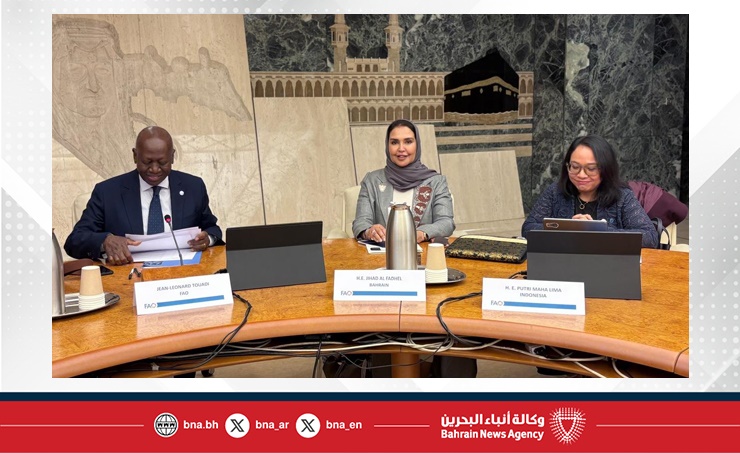
Rome, Nov. 10 (BNA): Dr. Jihad Abdullah Al Fadhel, Second Deputy Chairperson of the Shura Council, participated in the preparatory meeting for the Third Global Parliamentary Summit against Hunger and Malnutrition, held at the headquarters of the Food and Agriculture Organisation of the United Nations (FAO) in Rome on November 10 and 11.
Dr. Al Fadhel presented a set of proposals to advance a parliamentary vision for food security, including the establishment of a parliamentary network for sustainable food security and a parliamentary observatory to monitor the right to food, comprising representatives of agricultural, health, and environmental committees from various parliaments, in co-operation with specialised organisations.
She also proposed launching green and food parliamentary budget programmes to assess national budgets from the perspective of food security and environmental sustainability, as well as introducing a Parliamentary Network for Food Security that underscores the role of parliaments in promoting the right to food and reviewing relevant national laws.
Dr. Al Fadhel highlighted the main global trends in boosting food security and nutrition, including increased focus on national food security strategies, the shift towards smart and sustainable agriculture to address water and resource shortages, and the integration of agriculture, health, education, and environmental sectors to build resilient and inclusive food systems. She also pointed to growing public awareness of healthy eating, responsible consumption, and food waste reduction, along with wider regional and international co-operation in financing, research, and capacity building.
She said that the Arab region faces major challenges such as water scarcity, desertification, heavy reliance on food imports, and the impact of climate change on production and supply chains. Food loss and waste, she added, remain key economic and environmental issues. She outlined the Kingdom of Bahrain’s efforts to build a sustainable national food system that enhances quality of life and ensures food security as an integral part of national security.
Dr. Al Fadhel noted that Bahrain is proud of the National Food Security Strategy (2020–2030), which seeks to diversify local production sources, increase agricultural and fisheries investments, and adopt modern smart farming technologies to improve water efficiency and reduce reliance on imports. The strategy also promotes integration between agriculture, health, education, and environmental sectors, positioning the Kingdom as a regional model for resilient and sustainable food systems capable of adapting to climate and economic challenges.
She underlined that Bahrain’s Legislative Authority plays an active role in enhancing national food security in line with global developments in food systems. The Shura and Representatives Councils have examined legislation related to agriculture, trade, health, and the environment to promote resource efficiency and ensure food equity. She added that parliamentary committees continue to monitor the progress of the National Food Security Strategy through constitutional tools during the review of draft laws and proposals. She also noted that members of both councils also work on drafting new legislation that supports agricultural innovation and investment in modern technologies, aligned with the UN Sustainable Development Goals.
Dr. Al Fadhel underscored that the Kingdom contributes effectively to joint GCC efforts to develop a unified food security strategy focused on aligning agricultural and food policies, sharing investments and expertise in smart and sustainable agriculture, and promoting joint scientific research.
She reiterated that food security is both an economic issue and a shared global responsibility, and that parliaments must play an active and influential role in addressing it.
