



RHF, UNHCR sign grant agreement to rehabilitate damaged housing in Damascus
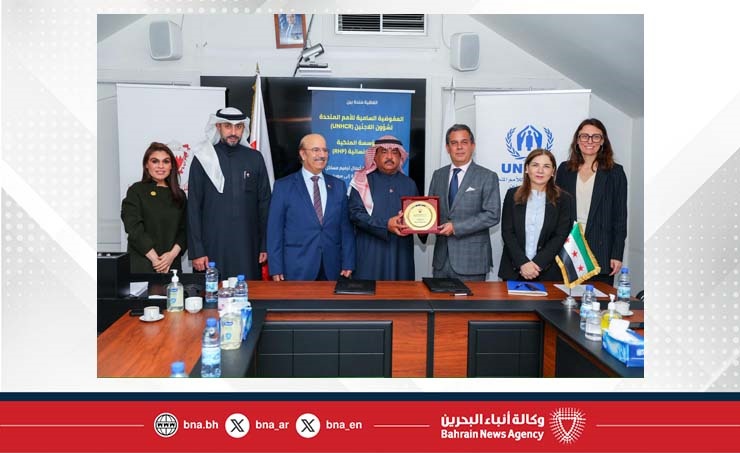
Manama, Feb. 2 (BNA): The Royal Humanitarian Foundation (RHF) has signed a grant agreement with the United Nations High Commissioner for Refugees (UNHCR) in Syria, valued at USD 2 million, to support the rehabilitation of damaged homes for returning families in Al Zarbah district in the Rural Aleppo governorate and the city of Harasta in Rural Damascus.
The agreement comes as part of ongoing efforts to improve living conditions and enhance stability in areas affected by the crisis.
The agreement was signed on behalf of the RHF by Ibrahim Dalhan Al Dosari, the Acting Secretary-General, and on behalf of UNHCR in Syria by Gonzalo Vargas Llosa, the Representative of the High Commissioner, in the presence of Ambassador Waheed Mubarak Sayyar, the Dean of the Diplomatic Corps in Damascus and Ambassador of the Kingdom of Bahrain to the Syrian Arab Republic.
RHF Acting Secretary-General said, "This agreement forms part of the Foundation’s ongoing humanitarian efforts to support communities affected by crises outside the Kingdom of Bahrain, and reflects its commitment to contributing to the rehabilitation of impacted areas through the implementation of humanitarian projects that provide safe housing and improve the quality of life for the most vulnerable families."
Al Dosari added that the Foundation places particular emphasis on supporting affected families returning to their areas of origin through effective partnerships with specialized international organizations, contributing to the achievement of sustainable humanitarian impact and enhancing opportunities for social and living stability for these families.
For her part, UNHCR Syria spokesperson Celine Schmitt said: "Through this grant, UNHCR will rehabilitate approximately 470 damaged residential homes, benefiting nearly 3,600 individuals." She added that the project aims to restore safe and dignified living conditions for vulnerable families returning to severely affected areas, with priority given to the most vulnerable households, including female-headed families and persons with disabilities.
Schmitt explained that rehabilitation works will include repairs to walls, roofs, and foundations, contributing to restoring safety and stability to homes, in addition to providing solar-powered lighting systems to support families in areas experiencing power outages or limited electricity supply. She noted that the project will also include repairs to essential water facilities and pipelines, as well as the installation of solar-powered water heaters, to ensure returning families have access to clean water and safe sanitary conditions.
On the sidelines of the agreement signing, a delegation from the Royal Humanitarian Foundation conducted field visits to a number of damaged homes in need of rehabilitation to closely assess the conditions and actual needs of affected families. The visit also included the headquarters of the Syrian Arab Red Crescent, as part of efforts to strengthen coordination and integration in humanitarian work. In addition, the delegation met with Mustafa Abdulrazzaq, Syria’s Minister of Public Works and Housing, to discuss avenues of joint cooperation in the fields of reconstruction and housing rehabilitation in affected areas.
