



Mekong Delta repositions as global tourism hub
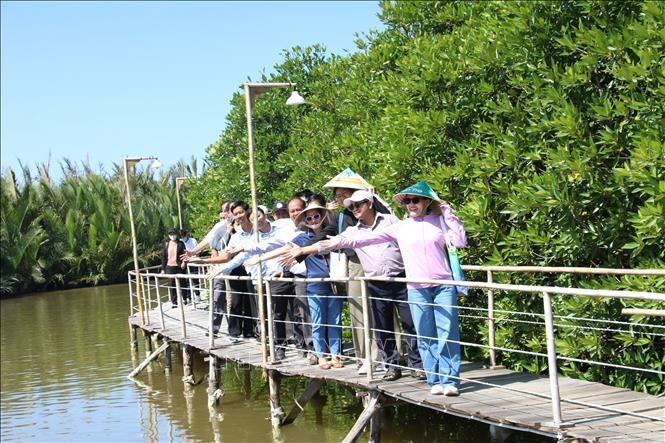
Can Tho, January 30 (VNA) — As one of Vietnam's primary tourism regions, the Mekong Delta is pivoting toward a sustainable future centred on green tourism, environmental protection, and the preservation of cultural heritage.
This strategic shift aims to uplift living standards while elevating the region’s status on the international tourism map.Spanning nearly 40,000 sq.km, the Mekong Delta is the nation’s agricultural powerhouse, contributing 50% of rice output, 65% of aquaculture, 70% of fruit production, 95% of rice exports, and 60% of fish exports.
Beyond being a "national food basket," the region serves as a strategic gateway to the East Sea and the Mekong Sub-region.
This dense network of rivers and canals provides an unparalleled foundation for riverine, agricultural, and community-based tourism.
Dr Tran Huu Hiep, Vice Chairman of the Mekong Delta Tourism Association, asserted that the region is a unique ecological and cultural space.
The core issue is not just having resources, but how to exploit them sustainably while balancing economic benefits with environmental responsibility, he noted.He emphasised that the region’s indigenous knowledge and rich agricultural ecosystems allow for a natural transition to integrated green tourism models.
In Vinh Long, located in the heart of the Delta, the shift is tangible.
Ho Trung Nhan, Director of the Vinh Long provincial Tourism Promotion Centre, highlighted that modern travellers now seek environmental commitment over mass commercialism.
The province is developing a "Green Heritage Corridor," linking the lush orchards of Vinh Long, the red ceramic heritage of Mang Thit, the coconut groves of Ben Tre, and the ancient Khmer pagodas of Tra Vinh.Innovative models are already gaining international recognition.
These include Sokfarm’s plastic-free organic coconut flower nectar tours and the "Net Zero tours" in Ben Tre. Notably, the Con Chim (Bird Islet) community tourism model recently secured the ASEAN Community Tourism Award 2025 for its "nature-compliant" approach.
Vo Van Phong, Director of C2T Tourism and Media, suggested that green tourism is about "doing things differently," ensuring that resources like forests and water continue to generate value after every visitor experience.
Meanwhile, Can Tho, the regional hub, is focusing on its 12 traditional craft villages to diversify its offerings. Destinations such as the Thuan Hung rice paper village and the Pho Tho - Ba Bo flower village are being upgraded to meet green standards.
Sam Long Giang, Deputy Director of the Can Tho city’s Department of Culture, Sports, and Tourism, stated that the city is actively creating a friendly investment environment to attract strategic partners.
By integrating traditional crafts with professional tourism services, the city aims to provide sustainable livelihoods for locals while maintaining its reputation as a safe, hospitable destination.
As the country enters a new era of development, experts shared the view that green transformation is no longer optional but a necessity for the region that is heavily impacted by climate change.
By repositioning its image through conservation and high-value experiences, the Mekong Delta is choosing a path of "slow but steady" growth.
This strategy ensures the region remains distinct and competitive, preserving the soulful identity of Southern Vietnam's riverine culture for generations to come.-VNA
